
a.k.a. The Clay Wade Bailey Bridge

| A timeline, to keep various C&O Bridges straight. | |
| 1886-1889 | The Original C&O Railroad Bridge built |
| 1929 | A new railroad bridge is built next to the old one; this new bridge is the current bridge for the railroad. |
| 1929 | The original RR bridge is sold to Kentucky; to be converted for use by auto traffic. |
| 1931 | The old railroad bridge is opened as the new auto and pedestrian bridge. |
| October 19, 1970 | Original RR bridge (auto traffic since 1929) is blown up. See pics below. |
| October 21, 1974 | New traffic bridge is opened; named for Clay Wade Bailey, a long time Kentucky Post reporter. |
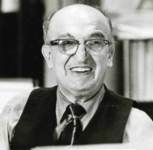
Clay Wade Bailey
Image from the Faces and Places Collection of the Mary Ann Mongan Library in Covington
 |
 |
 |
 |
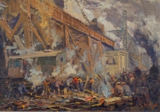
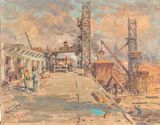
| Louis Charles Vogt gave us several paintings of industrial scenes. We have seen the two images on the left both described as the C&O Bridge, but have also seen them labeled as New York's Queensborough Bridge. We have more confidence that the two images on the right are, indeed, by Vogt of the C&O Bridge. | |||
 |
 |
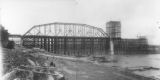 |
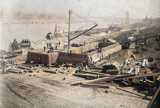
| Building the caisson on the Kentucky Side | C & O Bridge Construction (late 1880's) | |
 |
 |
|
| C & O Bridge Construction (late 1880's) | 1886 From a Facebook post by Kurt Hultquist |
 |
 |
| The original C&O Railroad Bridge, c. 1890's |
An early drawing of the C & O Railroad Bridge |
The planning for the 1928 bridge.
The dedication of the 1928 bridge.
The dedication of the 1931 bridge.
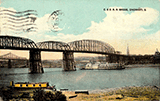
Chesapeake and Ohio Bridge, c, 1930
 |
 |
 |
| Looking toward Covington | note foreground | 1929 |
| “Chesapeake” & Ohio Bridge | The Chesapeake and Ohio Railroad Bridge |
The Chesapeake and Ohio Railroad Bridge |

A fascinating image. Note there's ice on the river, a crowd on the shore, and a trolley passing over the old C&O bridge. The steamer you see here, the Cincinnati, was destroyed by the ice of 1917-18, and our speculation, and its just that, speculation, is that you're seeing a crowd watching the last throes of a mighty side wheeler. |
 |
 |
 |
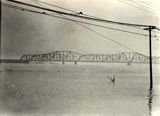
| C & O Bridge, 1937 | The C&O Bridges in the 1937 Flood. Looking upstream. |
Under the C&O Bridge, looking toward Covington |
 |
 |
 |
 |
| Construction and grand opening of 1929 Bridge |  |
 |
|
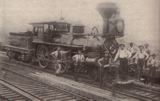
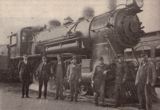
To the right are the first locomotives, and crews to go over the first 1889 C&O Bridge, and the rebuilt
C&O RR Bridge on April 3, 1929. You can click on the captions under the pictures.
The above four images are all from the 1929 L&N Employees Magazine. The accompanying story is here.
A more detailed story on the rebuilding is from a 1928 Railway Age (pdf).
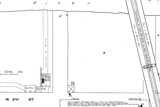
| Just FYI, this detail from a 1909 Sanborn fire map, shows a walking and wagon path on each side of the tracks. |
 |
 |
| C & O Railway Bridge | Cities Highway Bridge |
 |
 |
 |
 |
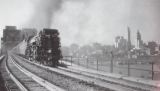
| C & O Bridge Traffic, circa 1945 | C & O in the 1950's | ||
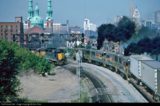
September 12, 1981. The C&O and the L&N pass
on the C& O Bridge Approach.
This pic is a copyrighted photo by Don Faris. Clicking on the thumbnail
will take you to a larger version at railpics.net, where the original resides.
 |
 |
||
| Pay attention children, this is called a passenger train. People rode in them. | The L & N had trackage rights over the C & O Bridge. This image is from 1965. |


The End of the C&O Bridge, October 19, 1970
Photos by Jack Klumpe

Same pic as above right, except in color.
Thanks! to Mike Martin for this one.
 |
 |
| Chessie crosses into Kentucky | Looking toward Ohio |
 |
| In the 1971 re-build |

This is the U. P. Schenck, built in 1876, and later re-named the Longfellow. There aren't pictures
of her as the Longfellow. In a thick fog on the morning of March 8, 1895, she hit the C&O
Railroad Bridge, and sank in three minutes. The story is here. The New York Times version of the
story is here
(pdf), and has a partial list passengers who drowned.
The river men blamed the bridge piers.
The Cincinnati Transit site has a page on the history of the
C&O Bridge, here, and on the Clay Wade Bailey Bridge, here.
